
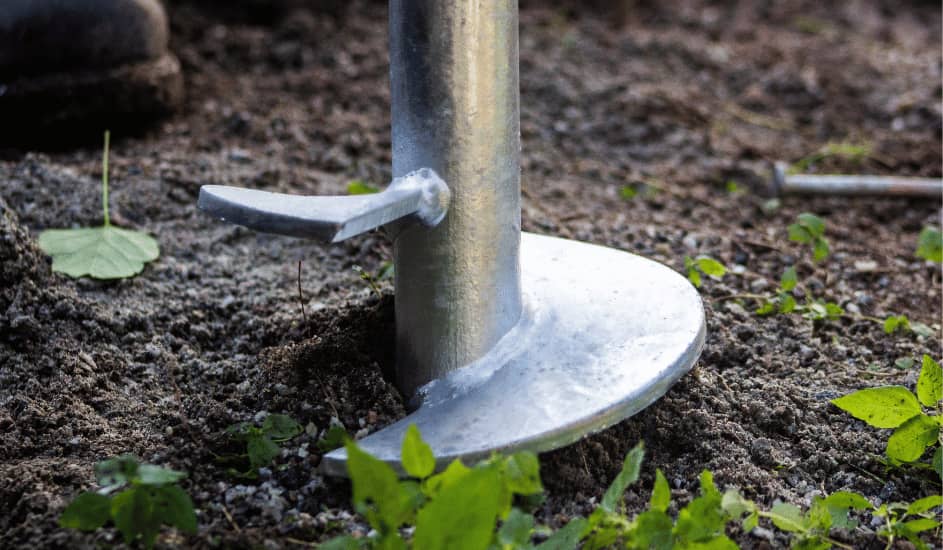


Yes, screw piles work extremely well in the clay soils common in parts of British Columbia when they are properly designed and installed. In fact, screw piles are often one of the best foundation solutions for clay because they bypass unstable surface soils and transfer loads into deeper, more consistent bearing layers.
At Screw Pile Installers, we regularly install foundations in clay heavy regions across British Columbia. Clay presents challenges for many foundation systems, but screw piles are engineered to address those challenges directly rather than fight against them.
Clay soils are widespread throughout BC, particularly in coastal lowlands, river valleys, and areas influenced by glacial deposits. These soils are made up of extremely fine particles that retain water and change volume as moisture levels fluctuate.
Common characteristics of clay soils include:
These traits are what make clay challenging for traditional shallow foundations.
Clay soils expand when wet and shrink when dry. This constant movement places stress on foundations that rely on shallow bearing or uniform soil conditions.
Problems commonly seen with traditional foundations in clay include:
In BC’s climate, where rainfall and soil moisture levels change seasonally, these issues are especially common.
Screw piles are uniquely suited for clay because they are installed deep enough to move beyond the most active zone of soil movement. Rather than relying on surface bearing, they anchor into deeper, more stable clay or underlying soil layers.
Key performance advantages include:
This makes screw piles far more predictable than shallow footings in clay conditions.
Some BC clay soils are considered expansive, meaning they undergo noticeable volume changes with moisture variation. These soils are particularly problematic for conventional foundations.
Screw piles reduce the impact of expansive clay by:
This dramatically reduces the risk of seasonal foundation movement.
Depth is one of the most critical factors when installing screw piles in clay. Shallow installations may still be influenced by moisture fluctuations and frost action.
Properly installed screw piles extend to depths where:
Depth is determined during installation using real time torque monitoring rather than assumptions.
Torque is a direct indicator of soil resistance and bearing strength. As a screw pile advances through clay, resistance increases with depth and density.
When target torque is reached, it confirms:
This verification process ensures reliable performance even in variable clay soils.
In colder regions of BC, clay soils are also susceptible to frost heave. When moisture laden clay freezes, it expands upward, lifting shallow foundations.
Screw piles address frost issues by:
This makes them ideal for regions that experience both clay related movement and seasonal freezing.
Clay drains poorly, which means water tends to remain near the surface after rainfall. This increases hydrostatic pressure and softens surface soils.
Screw pile foundations allow water to move naturally through the soil profile without being trapped against a foundation wall or footing. This reduces long term moisture related issues and improves site stability.
Homeowners in clay heavy areas often choose screw piles for:
Screw piles provide predictable performance and reduce the risk of future settlement or movement.
Clay soils are also common beneath commercial and light industrial projects. Screw piles are widely used for:
Their ability to support higher loads while bypassing unstable clay layers makes them a reliable choice.
Concrete foundations in clay soils often require:
Even with these measures, settlement issues can still occur.
Screw piles typically offer:
In many cases, they are the more efficient and cost effective option.
Clay soils can become extremely difficult to work with when wet. Excavation can be delayed for weeks due to poor drainage and unstable trench walls.
Screw piles can be installed in:
This flexibility keeps projects moving and reduces construction delays.
Properly installed screw piles provide long term stability in clay by isolating structures from soil movement. Over time, this results in:
For property owners in clay heavy regions, this peace of mind is invaluable.
While screw piles perform well in clay, certain conditions may require additional design considerations, including:
In these cases, pile design and spacing are adjusted to ensure performance.
Clay soils vary significantly even within the same site. Proper evaluation, equipment, and experience are essential.
At Screw Pile Installers, we assess clay conditions during installation and adapt depth and design in real time. This approach ensures every pile performs as intended.
Yes. Screw piles are highly effective in clay soils when installed to proper depth and verified by torque.
No. Screw piles bypass expansive clay layers, minimizing the impact of seasonal movement.
Depth varies by site, but piles are installed below active clay layers to reach stable bearing soil.
Wet clay does not prevent installation. Load capacity is confirmed during installation through torque monitoring.
No. With proper corrosion protection and design, screw piles offer decades of service life.
In many cases, yes. Screw piles provide more predictable performance and faster installation in clay soils.
So, do screw piles work in clay soils common in parts of BC? Absolutely. When properly designed and installed, screw piles are one of the most reliable foundation solutions for clay conditions.
They address the root causes of clay related foundation problems rather than trying to manage symptoms through over excavation and soil replacement.
Call Us For A Quote: (855) 918-7453
Screw Pile Installers is the leading helical screw pile foundation installer in British Columbia and Alberta, trusted for residential and commercial projects in challenging clay soil conditions.

.svg)
.svg)
.svg)
.svg)

.svg)

.svg)


.svg)