Screw Pile Foundations For Energy & Utility Infrastructure in BC, & Alberta
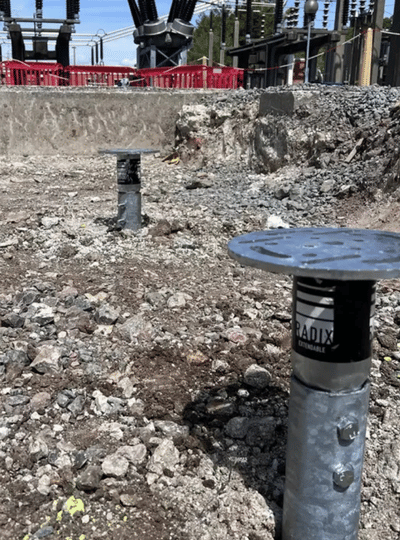
We help energy and utility operators across British Columbia and Alberta build critical infrastructure with confidence by delivering helical pile foundation systems for power generation, transmission lines, pipelines, substations, and renewable installations. Our solutions support fast installation, proven load capacity, and long-term reliability while reducing construction risk in demanding environments.
Whether you’re building on clay, sand, slopes, or frost-prone terrain, our screw piles provide unmatched stability and faster installation than traditional concrete footings.
Engineered Foundations for Critical Infrastructure
Infrastructure assets must remain operational for decades with minimal maintenance or downtime. Helical piles offer a dependable alternative to traditional concrete foundations, delivering immediate load verification and reduced site impact while meeting the demands of critical energy and utility systems.
From new installations to upgrades and retrofits, our foundations are designed to support heavy equipment, resist uplift and lateral forces, and perform consistently across varied terrain.
WHY CHOOSE US
Why Helical Piles Are Ideal for Energy & Utility Projects
Whether supporting transmission lines, pipeline supports, or power equipment, helical pile foundations provide certainty and speed where failure is not an option.
Designed to handle axial, lateral, and uplift loads common in towers, substations, and equipment foundations.
Rapid Deployment
Install foundations quickly with no concrete curing, ideal for outage windows and tight construction schedules.
Remote and Difficult Access
Compact installation equipment allows access to remote corridors, right of ways, and confined sites.
All Season Installation
Install in frozen, wet, or unstable soils without delays caused by weather or ground conditions.
Minimal Environmental Impact
Reduced excavation helps protect surrounding land, waterways, and sensitive environments.
Long Term Reliability
Galvanized steel piles resist corrosion and settlement, supporting infrastructure assets for decades.
Our Process
Our Infrastructure Foundation Process
We follow a structured, engineering-led process to ensure every foundation meets performance, safety, and compliance standards.
[01]
Engineering Review & Site Analysis
We assess geotechnical data, load requirements, environmental constraints, and access conditions to define the optimal pile configuration.
[03]
Helical Pile Installation
Using high torque hydraulic drive systems, piles are installed to engineered depth and verified torque values, confirming required capacity during installation.
[05]
Structural Interface Installation
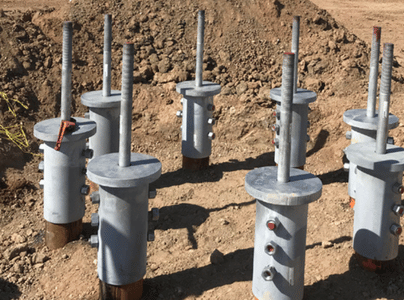
Custom brackets, caps, or beams are installed to connect piles to equipment skids, towers, or concrete elements.
[02]
Alignment & Layout Planning
Pile locations are coordinated with equipment layouts, anchor points, and structural drawings to ensure precise placement.
[04]
Load Verification & Reporting
Torque data and load testing results are documented and supplied for engineering review, inspections, and regulatory records.
[06]
Final Inspection & Site Restoration
A full quality inspection is completed, and the site is left stable, clean, and ready for commissioning or construction.
Comparison
Helical Piles vs. Concrete for Energy & Utility Infrastructure
Yes. Helical piles are engineered to support high axial, lateral, and uplift loads common in energy and utility infrastructure.
Absolutely. Minimal excavation and compact equipment make helical piles ideal for protected areas and remote access sites.
Yes. Our systems are installed to engineered specifications and meet applicable codes and utility requirements when coordinated with project engineers.
With proper galvanization and installation, helical piles commonly exceed 75 years of service life, even in aggressive soil conditions.
While unit costs vary by load and site conditions, helical piles often reduce total project costs by shortening schedules, minimizing excavation, and lowering environmental remediation expenses.
Ready To Build Your New Screw Pile Foundation?
From sandy lakeshores to rocky slopes, wetlands to frozen ground screw piles deliver unmatched stability, no matter the conditions.



.svg)
.svg)
.svg)

.svg)
.svg)
.svg)
.svg)
.png)
.png)
.png)
.png)
.png)
.png)

.svg)
.svg)


.svg)
.svg)
.svg)
.svg)

.svg)

.svg)