AboutBecome a DealerFAQContact

Screw Pile Foundations vs. Concrete Foundations: Which Is Better?

When building a structure that lasts, the foundation matters most. While traditional concrete foundations have long been the standard, modern screw pile foundations offer faster installation, lower costs, and superior long-term performance.

What Are Screw Pile Foundations?

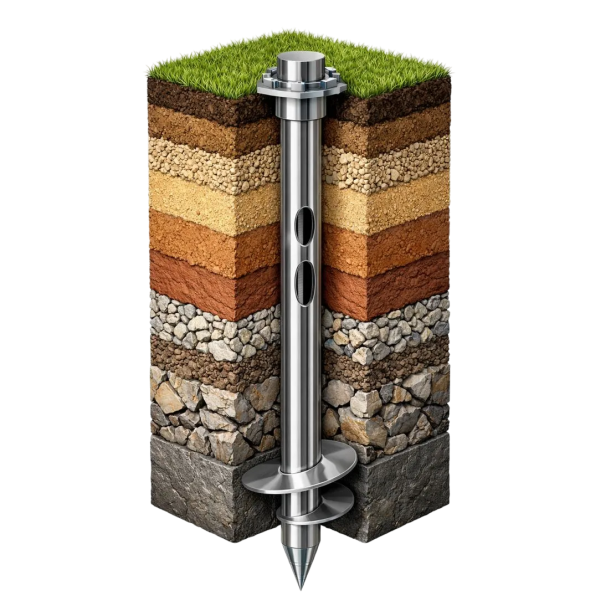
Screw piles (also called helical piles) are steel shafts with helical blades that are screwed deep into the ground using hydraulic equipment. They provide immediate load-bearing capacity and can be installed in nearly any soil or season — without curing or excavation.

Material

Galvanized steel shaft with helical plates

Installation

Hydraulic torque-driven (no concrete)

Load Capacity

Verified by real-time torque monitoring

Performance

Works in clay, sand, loam, frost, and moisture

Maintenance

Minimal – long lifespan (75+ years)

What Are Concrete Foundations?

Screw piles (also called helical piles) are steel shafts with helical blades that are screwed deep into the ground using hydraulic equipment. They provide immediate load-bearing capacity and can be installed in nearly any soil or season — without curing or excavation.

Material

Cement, aggregate, water (high CO₂ footprint)

Installation

Excavation, form setup, concrete pour & cure

Load Capacity

Achieved after curing (delayed)

Performance

Limited by weather and ground moisture

Maintenance

Can crack, shift, or settle over time
Comparison

Head-to-Head Comparison: Screw Piles vs. Concrete Foundations

See how screw piles stack up against traditional concrete foundations.
Category
Installation Time
Seasonal Flexibility
Soil Disturbance
Load Verification
Load Verification
Load Verification
Load Verification
Load Verification
Reusability
Screw Pile Foundations
Installed in hours, ready to build immediately
Minimal excavation
Installable year-round (even frozen ground)
Low carbon footprint, recyclable materials
Real-time torque monitoring
Resistant to frost heave, shifting, and corrosion
Can be removed and reused
Lower total labor and material cost
Decks, homes, cabins, industrial pads, solar, and fencing
Concrete Foundations
Requires curing for days or weeks
Heavy excavation and backfill required
Delayed in cold/wet conditions
High CO₂ emissions from cement production
Requires later testing or inspection
Prone to cracking and movement over time
Permanent, cannot be reused
Higher material, transport, and curing costs
Slab-on-grade, basements, or decorative concrete projects
8%

Concrete contributes 
to global CO₂

75-100

Years lifespan 
(Screw Piles)

30-50

Years before major repairs (Concrete)

100%

Reusable & recyclable (Screw Piles)

Same Day

Ready to build 
(Screw Piles)

Why Add Screw Piles to Your Service Lineup?

Replace traditional concrete foundations with a faster, cleaner, higher margin solution built for modern construction.

Faster Installation

Installed within hours — no waiting for concrete to cure
Ready for immediate construction

All-Season Performance

Works in frozen, wet, or unstable soil
Year-round installation without weather delays

Lower Overall Cost

No excavation, concrete, or trucking costs
Fewer crew hours and faster turnaround reduce project budgets

Environmentally Sustainable

No concrete = no cement-related CO₂ emissions
Reusable, recyclable, and low-impact on the surrounding soil

Superior Long-Term Stability

Anchors deep into stable soil layers
Resists shifting, frost heave, and settlement that affect concrete

Immediate Structural Load

Ready to build on the same day
Perfect for tight construction timelines and modular projects

When Concrete Foundations Still Make Sense

While screw piles are the preferred option for most modern builds, concrete may still be suitable for specific scenarios.
Large continuous slabs (e.g., basements, warehouses)
Provides integrated slab and floor system
Municipal or code-restricted projects
Certain building codes specify concrete-only
Aesthetic or architectural finishes
Decorative or visible concrete elements
impact

Environmental Impact Comparison

Choose the foundation that's better for your project and the planet.

Site Impact

Screw Piles
Minimal soil disruption
Concrete
Major excavation required

Site Impact

Screw Piles
Minimal soil disruption
Concrete
Major excavation required

Site Impact

Screw Piles
Negligible
Concrete
High during concrete mixing

Site Impact

Screw Piles
75–100 years
Concrete
30–50 years before major repairs

Site Impact

Screw Piles
Very Low
Concrete
Very high (cement production = ~8% of global CO₂)

Why More Builders Are Switching to Screw Piles

Across Western Canada, more builders and property owners are turning to screw piles for their speed, versatility, and long-term performance. With faster installations, reduced environmental impact, and proven durability, screw piles offer a modern foundation solution that outperforms concrete in every way.
Large continuous slabs (e.g., basements, warehouses)
Year-round reliability in any soil or season
Lower costs and less downtime
Reduced carbon footprint and no curing delays
Proven lifespan of 75+ years
For homeowners, contractors, and engineers seeking a faster, stronger, and greener foundation system, screw piles deliver lasting value with less effort.

Ready To Build Your New Screw Pile Foundation?

From sandy lakeshores to rocky slopes, wetlands to frozen ground screw piles deliver unmatched stability, no matter the conditions.
© 2025 Screwpile. All Rights Reserved